
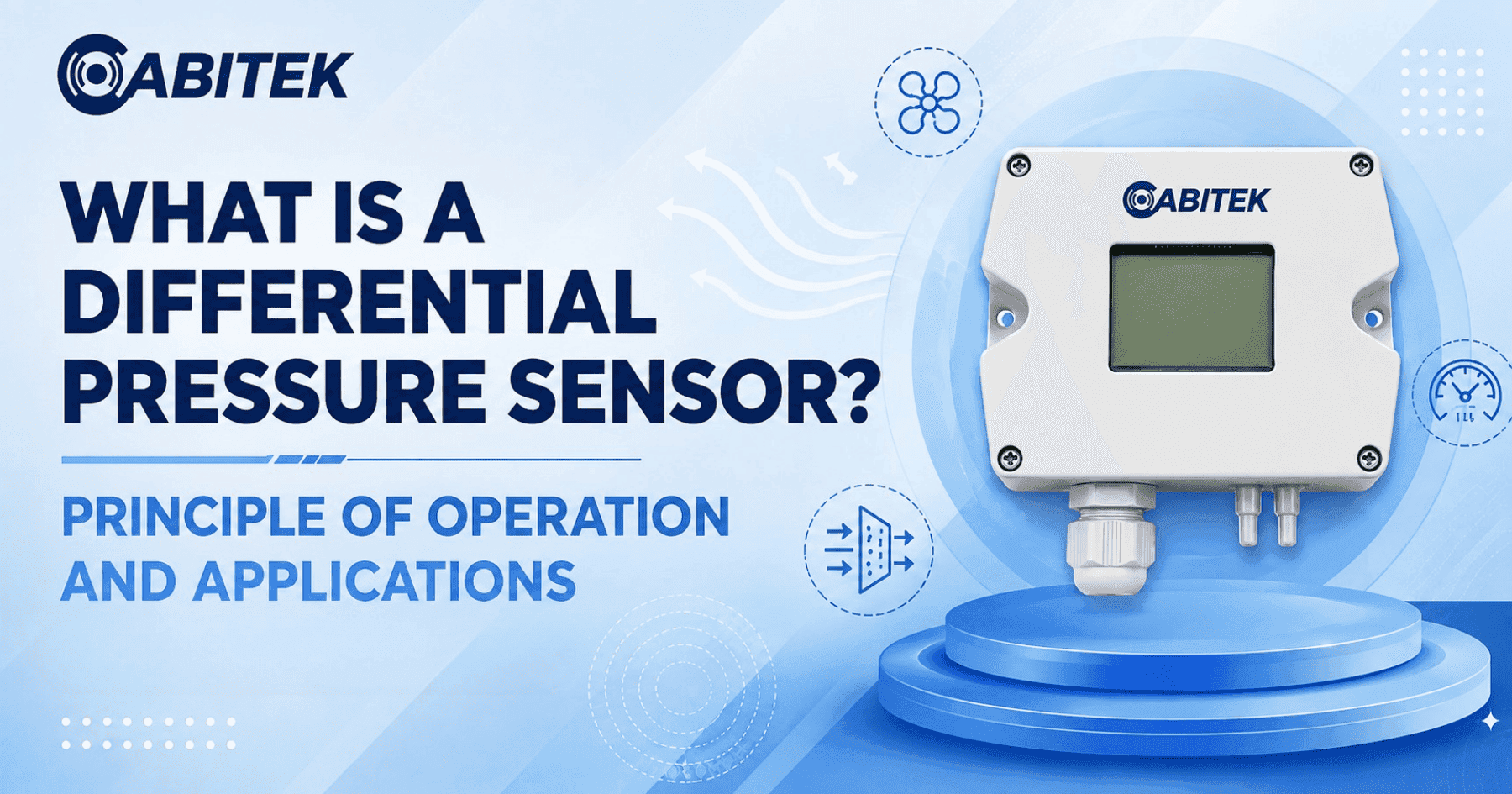

A Differential Pressure Sensor is a device used to measure the difference in pressure between two points, commonly denoted as ΔP. The device features two pressure ports: a high-pressure port (H) and a low-pressure port (L). The sensor compares the pressure at these two ports and converts the differential pressure value into electrical signals such as 4–20 mA, 0–10 V, or digital Modbus RTU signals to send to PLCs, BMS, SCADA, or control systems. So, what is a differential pressure sensor, how does it work, and how is it applied in practice? Let’s explore in detail with Cabitek through the article below.
What Is a Differential Pressure Sensor for Air?

A Differential Pressure Sensor for Air is designed to measure the pressure difference between two points, P1 and P2, in media such as gases, steam, or liquids. The device determines the differential pressure value using the formula ΔP = P2 – P1, thereby providing vital information about operational efficiency, flow conditions, or system blockage levels.
In practice, differential pressure sensors may be called by various names depending on their design and function, commonly including:
- Differential Pressure Sensor
- Differential Pressure Transmitter
- Differential Pressure Transducer
These devices are widely applied in HVAC, filtration systems, pipelines, flow measurement, and industrial automation systems.
Operating Principle of Differential Pressure Sensor for Air

A differential pressure sensor operates based on the principle of comparing pressure between two inputs: a high-pressure port (H) and a low-pressure port (L). When there is a difference in pressure between the two ends, the force acting on the sensing element—such as a diaphragm or an electronic measuring element—causes a corresponding variation. This variation is processed and converted by the sensor into an output signal in the form of voltage, current, or a digital signal. The signal can then be transmitted to PLCs, SCADA, BMS, or control and monitoring systems to accurately track pressure status and system operations.
Structure of a Differential Pressure Sensor for Air

A typical differential pressure sensor consists of several components working together to receive, measure, and convert the pressure difference into an output signal. Basically, the device includes pressure ports, a sensing diaphragm, a sensor element, a signal processing circuit, and a protective housing.
Two High–Low Pressure Ports
The differential pressure sensor has two inputs to receive pressure from two different locations in the system:
- High Port (H): Connected to the side with higher pressure.
- Low Port (L): Connected to the side with lower pressure.
Depending on the model, connection ports can use threads, flanges, or flexible tube connectors, which are particularly common in HVAC systems and cleanrooms. These two ports allow the sensor to accurately determine the pressure difference between the two measurement points.
Sensing Diaphragm
The sensing diaphragm is one of the most critical components, directly subjected to the pressure difference between the H and L ports. The diaphragm can be made from materials such as 316L stainless steel, silicon, or ceramic, depending on the technology and application range. When the pressure between the two sides changes, the diaphragm deforms accordingly. The degree of deformation serves as the basis for determining the differential pressure value.
Sensor Element
The sensor element is responsible for detecting the deformation of the diaphragm and converting it into an electrical signal. Depending on the design, the sensor may utilize common technologies such as:
- Piezoresistive: Detects changes in electrical resistance when the sensing element deforms.
- Capacitive: Determines changes in capacitance caused by the movement of the diaphragm.
- MEMS: Uses micro-electro-mechanical systems technology to create sensing elements with small dimensions and high sensitivity.
This component directly impacts the accuracy, sensitivity, and response capability of the sensor.
Signal Processing and Conversion Circuit
The signal generated by the sensor element is usually very small and requires processing before being sent to the control system. The internal electronic circuit performs functions such as:
- Amplifying and processing signals.
- Error calibration.
- Temperature compensation.
- Converting signals into standard output forms like 4–20 mA, 0–10 V, or RS485 Modbus RTU.
As a result, the sensor can easily connect to PLCs, SCADA, BMS, and other monitoring and control systems.
Protective Housing
The protective housing safeguards internal components from environmental impacts such as dust, moisture, vibration, and impacts. Depending on application requirements, the sensor housing can be made of engineering plastic, die-cast aluminum, or stainless steel, achieving protection ratings such as IP65, IP67, or higher.
Classification of Current Differential Pressure Sensor for Air
In today’s market, differential pressure sensors are categorized into various types based on criteria such as measurement technology, pressure range, output signal, and operating environment. Classification helps users easily select the right device for their technical requirements and actual operating conditions.
Classification by Measurement Technology
| Technology | Operating Principle | Advantages | Common Applications |
|---|---|---|---|
| Piezoresistive | Measures changes in electrical resistance of the sensing element when the diaphragm deforms | High accuracy, stability, and fast response | Industrial, hydraulics, pressure measurement systems |
| Capacitive | Detects changes in capacitance as the sensing diaphragm moves | High sensitivity, suitable for low pressure ranges | HVAC, cleanrooms, ventilation systems |
| MEMS | Applies micro-electro-mechanical systems technology to manufacture sensing elements | Small size, low power consumption, reasonable cost | OEM devices, measuring equipment, and commercial applications |
Classification by Measurement Range
| Sensor Type | Reference Range | Common Applications |
|---|---|---|
| Low Differential Pressure | A few Pa to a few kPa | Cleanrooms, HVAC, ventilation systems, electrical cabinets |
| Medium Differential Pressure | From kPa to a few bar | Filtration systems, water pipelines, pump systems |
| High Differential Pressure | Tens to hundreds of bar | Heavy industry, oil & gas, chemicals, and hydraulics |
Actual ranges depend on the specific model and manufacturer, so it is necessary to select a sensor with a range suitable for the system’s pressure.
Classification by Output Signal
| Output Signal | Characteristics | Suitable Applications |
|---|---|---|
| 4–20 mA | Good noise resistance, stable signal transmission over long distances | PLC, SCADA, and industrial automation systems |
| 0–10 V | Analog signal, easy to integrate and process | HVAC, BMS, and small-scale control systems |
| RS485 Modbus RTU | Digital data transmission, supports connecting multiple devices on the same network | BMS, SCADA, and centralized monitoring systems |
Classification by Operating Environment
| Operating Environment | Sensor Characteristics | Technical Requirements |
|---|---|---|
| Cleanroom | Ability to measure low differential pressure, high sensitivity | Low error, good stability, and fast response |
| Industrial Environment | Robust protective housing, resistant to environmental impacts | IP65–IP67 protection rating, vibration resistance, dust and moisture protection |
| Gas or Liquid Environment | Design suitable for specific media types | Corrosion-resistant materials, suitable pressure and temperature resistance |
Choosing a differential pressure sensor should not rely solely on price; it requires evaluating the range, accuracy, output signal, construction materials, protection rating, and environmental conditions to ensure stable and accurate operation over time.
Practical Applications of Differential Pressure Sensor for Air

Thanks to their ability to accurately measure pressure differences between two points, differential pressure sensors are widely used across various fields, from HVAC, oil & gas, and chemicals to water treatment, food & beverage, pharmaceuticals, and energy.
Applications in HVAC Systems
In Heating, Ventilation, and Air Conditioning (HVAC) systems, differential pressure sensors are used to:
- Monitor pressure differences in ventilation and air conditioning systems to ensure stable airflow.
- Track filter conditions and detect clogging levels to issue cleaning or replacement alerts.
- Combine with control systems to automatically adjust airflow via fans, dampers, and related equipment.
Applications in the Oil & Gas and Chemical Industries
In oil, gas, and chemical environments, differential pressure sensors play a crucial role in monitoring and controlling operations:
- Track differential pressure in oil and gas pipelines to maintain stable flow rates.
- Monitor filter clogging during oil and chemical processing.
- Control pressure in storage tanks, pipelines, and process equipment to minimize risks of exceeding safe limits.
Applications in Water and Wastewater Treatment
Differential pressure sensors are used in various stages of water supply and wastewater treatment systems, such as:
- Measuring liquid levels in tanks, water reservoirs, or water towers using the differential pressure measurement method.
- Checking the operational status of pumps and filtration systems.
- Monitoring pressure differences along pipelines to detect blockages, anomalies, or system leaks.
Applications in the Food & Beverage Industry
On food and beverage production lines, these devices are used to:
- Monitor pressure inside raw material tanks and processing equipment.
- Track filter status during processing and packaging.
- Control pressure in lines supplying CO₂, compressed air, or process steam.
Applications in the Energy Sector
In power generation and energy conversion systems, differential pressure sensors assist in process monitoring and operational performance optimization:
- Monitor differential pressure in boilers, pipelines, and turbine systems.
- Monitor pressure parameters in solar energy, wind power systems, and auxiliary equipment.
- Detect abnormal signs through differential pressure changes, enhancing overall system reliability.
Applications in Pharmaceuticals and Healthcare
For environments requiring strict control—such as cleanrooms, pharmaceutical manufacturing, and medical facilities—differential pressure sensors are used to:
- Control pressure differences between areas within cleanrooms.
- Maintain proper airflow direction to minimize cross-contamination risks.
- Monitor clean air supply systems for operating rooms, testing laboratories, and specialized medical zones.
Other Special Applications
In addition to the above sectors, differential pressure sensors are also used in:
- Research and Laboratories: Measuring and analyzing pressure variations in test setups.
- Transportation: Monitoring pressure in pneumatic systems, brakes, or auxiliary equipment on trains, aircraft, and electric vehicles.
- Industrial Automation: Interfacing with PLCs, SCADA, or BMS to gather real-time data and control systems.
Overall, differential pressure sensors not only deliver accurate measurements but also assist in monitoring equipment status, optimizing efficiency, detecting early faults, and reducing maintenance costs. They are among the vital measurement devices in modern industrial control and automation systems.
Key Technical Parameters to Consider When Selecting a Differential Pressure Sensor for Air
To select a suitable differential pressure sensor and ensure accurate, stable real-world operation, several factors related to the system and installation environment must be evaluated. Key criteria include:
- Pressure Measurement Range: Determine the minimum and maximum differential pressure to be measured to choose a sensor with an appropriate range, avoiding overload or inaccurate readings.
- Type of Media: Identify the media being measured—such as air, water, gas, steam, or chemicals—to select compatible wetted materials and sensor design.
- Environmental Conditions and Accuracy: Assess factors like temperature, humidity, vibration, electromagnetic interference, and accuracy requirements to select a device suited for operational conditions.
- Safety Standards and Certifications: For specialized systems, verify required certifications such as SIL 2/SIL 3, ATEX, EN ISO 13849, or related standards to ensure the device meets system safety requirements.
Where to Buy Genuine and Reliable Differential Pressure Sensors?

Cabitek is a leading reputable provider of sensor solutions and industrial automation measurement devices in Vietnam. When purchasing air differential pressure sensor products such as the (DP101) at CABITEK, customers can be fully confident in quality and support policies:
- 100% genuine products with complete CO/CQ documentation.
- Experienced engineering team to advise on precise configurations tailored to your needs.
- Competitive pricing with long-term warranty policies.
- Dedicated technical support throughout installation and operation.
Conclusion
Differential pressure sensors are essential devices in industrial measurement and control systems, helping to accurately monitor pressure differences between two points. Operating on the principle of converting differential pressure into electrical signals, these devices easily integrate with PLCs, SCADA, BMS, and automation systems. Thanks to their stable measurement capabilities, high precision, and versatile applications, differential pressure sensors are widely used in HVAC, air filtration, cleanrooms, water treatment, pipelines, and industrial processes. Selecting the correct measurement range, media, connection type, and output signal ensures effective, safe system operation while optimizing costs.